The Historic Town Process – Rebuilding Kentucky’s Streets One Building at a Time
Updated: Mar 11
A behind-the-scenes look at how Historic Town prints are carefully photographed,
reconstructed, and refined.
The Historic Town Process is built on photographing each building individually and reconstructing the streetscape with careful attention to scale, perspective, and feeling.
The Historic Town collection is not created from a single photograph. Each streetscape is carefully constructed by photographing every building individually and rebuilding the scene piece by piece.
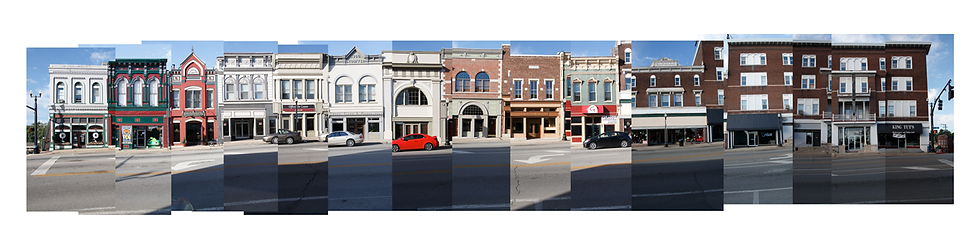
Historic Richmond is one example of this process, and it is the only piece where I have a clear before-and-after image to show how the transformation happens. But the same method is applied to every Historic Town print.
Before and After: The Historic Richmond Reconstruction
The images below show how the Historic Richmond streetscape began and how it was reconstructed through the Historic Town Process.

Precision in Capture – Planning Before Reconstruction
The process begins long before Photoshop.
When I set up to photograph each building, the lens must be positioned directly in front of the storefront. This reduces perspective distortion and keeps the structure visually balanced. If I were to stand at an angle and try to capture multiple buildings at once, the perspective would stretch and compress the architecture in unnatural ways.
By photographing each building individually — straight on — I preserve the natural appearance of entrances, windows, and architectural lines.
In addition, I always capture a portion of the buildings to the left and right of the one I am focusing on. This overlap is intentional. It allows me to understand the true scale of each structure when resizing and aligning them later.
By including parts of neighboring buildings, I can accurately match roof-lines, sidewalk heights, and architectural proportions. This removes guesswork and ensures that when the streetscape is rebuilt, everything connects naturally and proportionally.
Scale is critical. Without it, the image may look assembled. With it, the scene feels unified.
Reconstructing the Streetscape
After the individual buildings are photographed, the reconstruction begins in Adobe Photoshop.
Many buildings require multiple images stitched together to capture their full height and detail. In some cases, four or five separate shots are needed for a single structure.
From there, the work becomes layered and detailed. Windows, reflections, trim, bricks, siding, overhangs, sidewalks, and shadows are refined individually. There is careful cloning, selecting, feathering, and blending involved to ensure each element fits naturally within the full streetscape.
If a vehicle blocks part of a storefront, I capture the visible portions first, then reposition myself to photograph the architectural details hidden behind the obstruction. Those pieces are later blended back into the image so the structure feels complete.
Trees may be replaced. Leaves may be restored. Skies are often rebuilt using three or four separate sky images to create a balanced and cohesive atmosphere.
Depending on the complexity of the scene, a Historic Town image can take weeks — sometimes months — to finalize.
Restoring Light, Atmosphere, and Feeling
Not every Historic Town image is captured under ideal conditions.
Some photographs are taken in winter when trees are bare and skies are gray. On those days, the town can feel quiet and muted — but that isn’t always how the place lives in memory.
Through selective color adjustments, contrast control, and careful tonal refinement, I restore warmth and light back into the scene. A winter image can be transformed into something that feels sunny, balanced, and inviting again.
This isn’t about changing the identity of the town. It’s about presenting it in a way that reflects how it feels when it’s alive — when the light is right, when the colors are rich, and when the atmosphere feels welcoming.
The goal is visual harmony and emotional clarity.
Why the Historic Town Process Matters
This method is applied to every Historic Town print — not just Historic Richmond.
The finished image may look effortless, but it is carefully constructed so perspective feels grounded, scale feels accurate, and the environment feels complete.
Art, to me, has always been about feeling.
If the image doesn’t feel right while I’m building it, I won’t release it. When it finally does feel right, I know it’s ready to hang in someone’s home or business.
That balance — between technical precision and emotional response — is what defines the Historic Town collection.
Historic Town Wall Art and Architectural Photography
Historic town artwork captures the character of small downtown districts, storefronts, and main streets that reflect the history of a community. These scenes often resonate with people who appreciate architectural detail, local heritage, and the feeling of walking through a historic town center.
Through careful photography and digital reconstruction, each image is designed to preserve the balance, scale, and atmosphere of the buildings as they appear in real life. The goal is not only to document the architecture, but to present historic town wall art that feels authentic and visually harmonious when displayed in a home or business space.
You can explore the finished work in the Historic Town Prints collection.